
February 16th and its era

Plan your visit
IMPORTANT INFORMATION FOR VISITORS
Due to reconstruction and the installation of a new exhibition, the museum will be open to pre-registered groups only from May to October 2026.
At this time, we invite you to visit the Gallery of the House of Signatories (Pilies St. 26).
Information and registration:
E-mail: [email protected]
Phone: +370 669 44148
Opening hours: Tuesday to Friday 10.00 to 18.00, Saturday to Sunday 12.00 to 17.00
The ticket office closes 15 minutes before closing time.
Ticket prices
- Adult – 6,00 €
- Concessions* – 3,00 €
Family ticket
- Small family (1 adult and 1–4 children) – 9,00 €
- Large family (2 adults and 1–4 children) – 15,00 €
Additional services
- Guided tours in Lithuanian or a foreign language (for groups of 1–20 people) – 20,00 € + admission tickets
- Extended guided tours in Lithuanian or a foreign language (for groups of 1–20 people) – 25,00 € + admission tickets
- Escape room game ticket (for groups of 1–6 people) – 40,00 €
- Educational classes for children from 4 years old and schoolchildren – 3,00 €
- Educational classes for adults – 3,00 € + admission ticket
Full-time pupils of schools of general education; full-time students of schools of higher education; citizens of the Republic of Lithuania and other countries of the European Union studying full-time in schools of higher education in the member states of the European Union; students of vocational education institutions; pensioners (under 80); persons who suffered from the occupations between 1939 and 1990 – political prisoners and deportees, former inmates of ghettos and concentration or other forced labour camps; persons who fought for the independence of the Republic of Lithuania and suffered from Soviet aggression on 11–13 January 1991 and onwards; participants in the resistance movement against the occupations between 1940 and 1990 – volunteer soldiers and freedom fighters; teachers; for soldiers in permanent compulsory military service and volunteer soldiers, soldiers of NATO forces serving in Lithuania; members of the Lithuanian Riflemen’s Union; cadets of the General J. Žemaitis Lithuanian Military Academy; members of the Lithuanian Armed Forces Volunteer Union. Discount is applied upon presentation of an appropriate ID.
Exposition is free of charge for the following visitors:
pre-school children; orphans and children who have lost guardianship by their parents; people with a disability and their one accompanying person; pupils with special educational needs and their one accompanying person; persons from 80 years of age; persons presenting a POLA (Association for Support of Oncological Patients) card; employees of Lithuania’s museums; members of the International Council of Museums (ICOM); residents of children care homes and socially supported children; teachers accompanying groups of schoolchildren; Vilnius Pass card holders (valid for visiting The New Arsenal, The Old Arsenal, The House of Signatories, Gediminas Castle Tower, The Bastion of the Vilnius Defence Wall, Kazys Varnelis House-Museum, House of Histories); students of Lithuanian art schools for children and youth; students of Vilnius College of Technologies and Design; students of Balys Dvarionas decennary music school; members of the Lithuanian Association of Art Historians; members of the International Association of Art Critics; members of the Lithuanian Association of Archaeologists; guides with valid guide ID; guides accompanying groups of tourists; journalists; Family Card holders; students of Vilnius Academy of Arts; students of the Faculty of History at Vilnius University; students of the Faculty of Communication at Vilnius university; students of the Klaipėda university; organised groups of up to 15 people by members of the Karaim Cultural Community in Lithuania, with the exception of Gediminas Castle Tower; members of the Public Institution “Public Initiatives Support Fund” accompanying Ukrainian groups; citizens of Ukraine; all visitors on the last Sunday of each month, except for temporary exhibitions at the House of Histories.
Educational activities of the National Museum of Lithuania’s expositional locations are free of charge for the following visitors:
children under 3 years of age; residents of children care homes and socially supported children; people with a disability and their one accompanying person; teachers accompanying groups of schoolchildren; citizens of Ukraine.
Concessions are applied upon the visitor providing valid ID that prooves right to specific concessions. This ID requirement does not apply to pre-school children and all visitors on the last Sunday of each month.
General guided and thematic tours are available in Lithuanian,English and Russian. Tours should be booked in advance by phone +370 (6) 694 4148 or email [email protected].
Museum tours can only be conducted by guides from the museum or an institution with which the museum has a contractual agreement.
Filming and photography
Visitors are allowed to take photographs in the exhibitions and displays without a flash or tripod, provided that these photographs are not reproduced or published. The Administration reserves the right to prohibit photography and filming in certain exhibition halls or temporary exhibitions. Journalists may use special equipment with the permission of the museum administration. The visitor is responsible for copyright infringements.
Adaptation for people with reduced mobility
The main exhibition areas of the Signatories’ House, such as the Independence Act Signing Room, as well as the sanitary facilities, are accessible to people with reduced mobility. For more information, please click here: download PDF.
Accessibility for the visually impaired
The museum is housed in a historic building with an interior layout characterised by small passageways and narrow staircases. The exhibition is spread over two floors, which are accessed by a lift and stairs. There is no tactile marking or tactile models in the museum, but you will be accompanied by an educator-guide who will tell you about the birth of the modern state of Lithuania and the exhibits. You will be able to touch some of the furniture, ancient ornamental stoves, and other interior details of the exposition, and thus feel the authentic spirit of the early 20th century building.
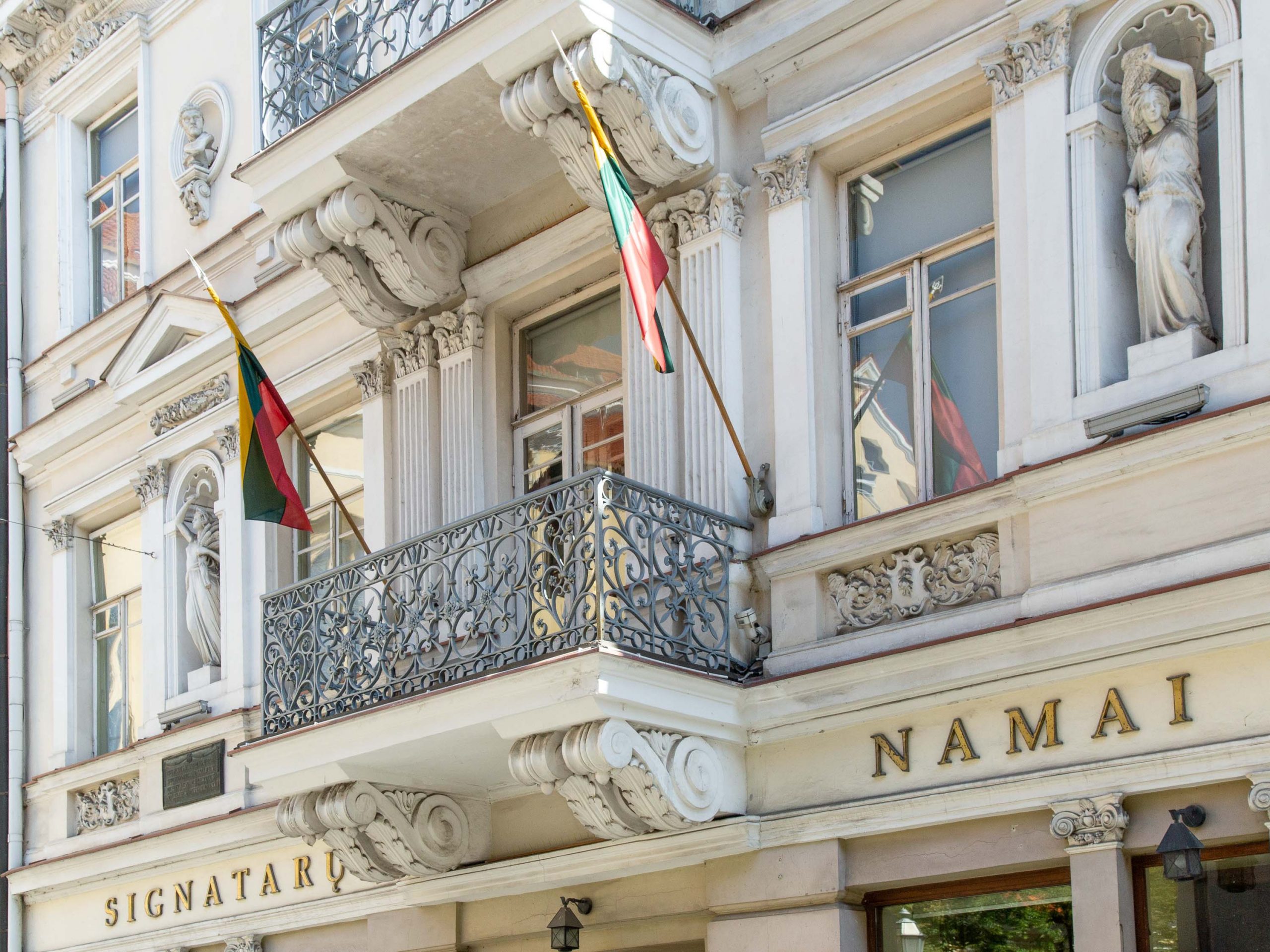
If you have notified us in advance, we can meet you at the entrance to the museum (Pilies str. 26; the entrance to the museum is in the courtyard). The facade of the museum is decorated with the inscription in large “golden” letters “House of Signatories”.
For those arriving on their own, please follow these links:
Coming from the Cathedral Square from the left side of Pilies Street, the museum is accessed through a 2 metre wide archway leading into the courtyard. The entrance is flanked by a metal gate, which is open during museum hours.
The entrance from the street to the courtyard has a hotel on the left and a café with outdoor tables on the right. There are metal stands with signs on the side of the entrance on Castle Street, please be careful.
To get to the museum, go deeper into the courtyard along the brick path until you reach the outdoor lift after about 13 metres. This takes you up to the museum. Warning: you will come to the glass side of the lift. The elevator door will be around the corner on your left.
There is a rubber floor mat in front of the lift door. The call button for the lift is on the right hand side of the lift door, at a height of approximately 1 m. Look for the lift control buttons on the left. The museum ticket office is on the second floor. The button for this floor is the second from the top.
The lift is a transfer lift with two doors. You will enter the lift through one door and exit through the other to enter the museum. On the second floor, from the lift, go forward 2 metres and turn right. You will be greeted by a member of the museum staff.
If you have any questions before your visit, please contact the Education Department at +370 652 93552 or [email protected].

About us
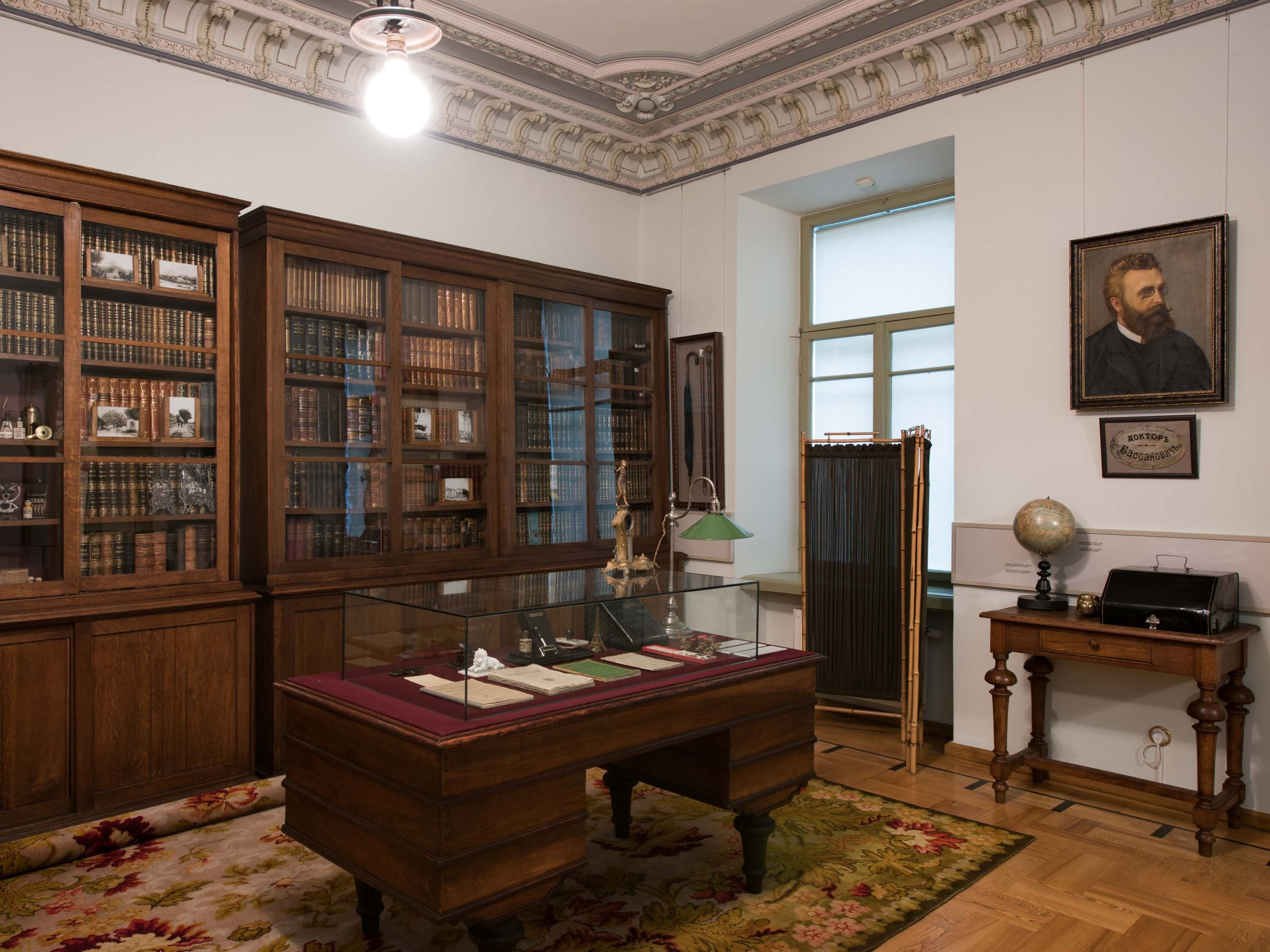
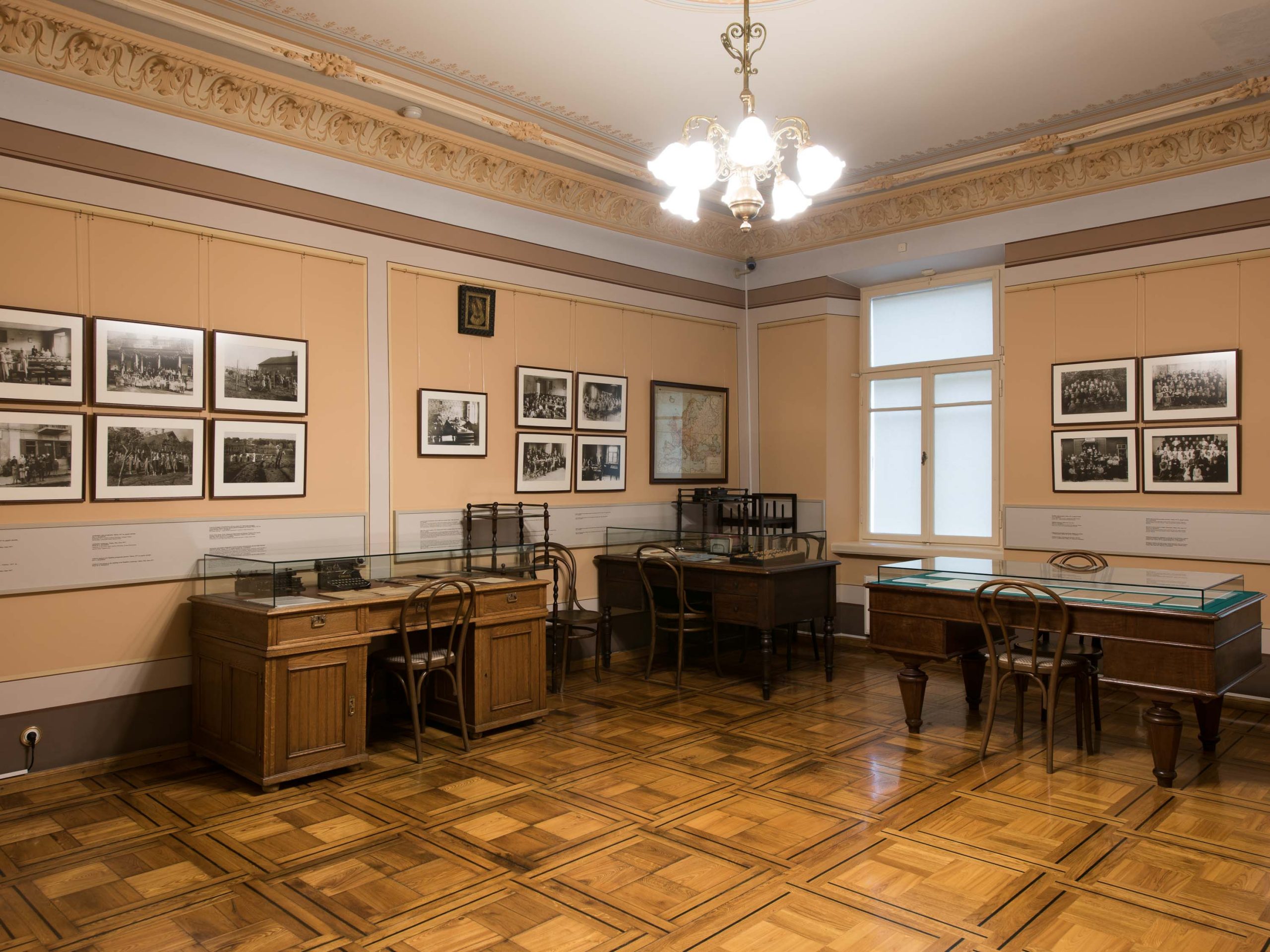
The House of Signatories uses traditional and contemporary techniques to present modern Lithuania’s path to statehood – from the mid-19th century to the seminal event of the signing of the February 16th Act of Independence.
What will you discover here?
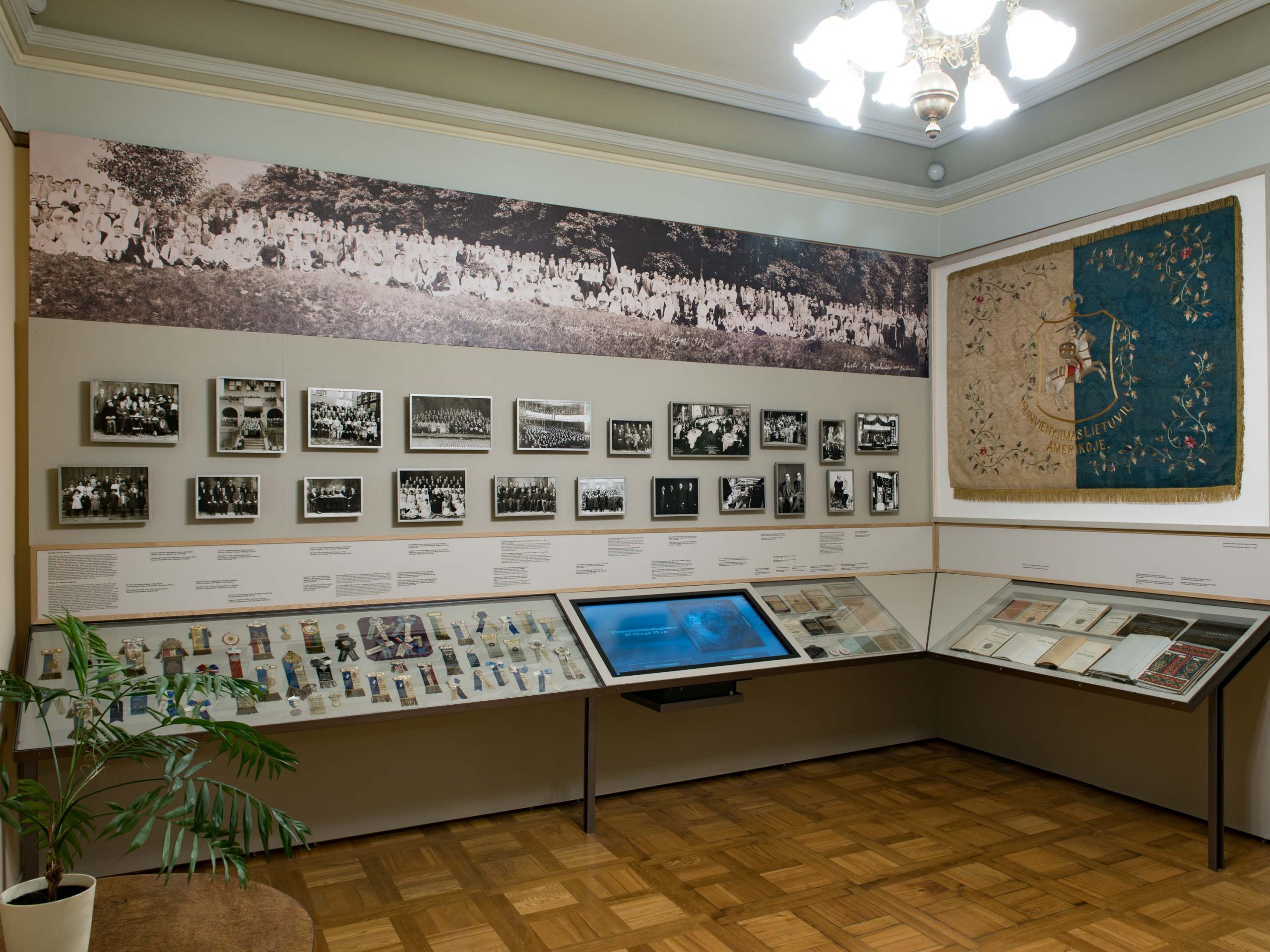
President Antanas Smetona’s gold pen, a gift he received on his name day; president Aleksandras Stulginskis’s “Zenith” brand watch, which ticked as the Act of Independence was being signed, while Stulginskis served as president, and during the time he spent in deportation in Siberia; you will hear the first audio recordings made in Lithuania – folk songs recorded by Jonas Basanavičius – as well as recordings of the Signatories themselves speaking about 16 February 1918; long-time Lithuanian ambassador to France Petras Klimas’s tuxedo, a memento of his many years of his diplomatic service and attended functions; an original 1900 flag of the Union of Lithuanians in America, by Jonas Šliūpas; a stuffed Eurasian Eagle-Owl that was raised by Jonas Basanavičius.
What will you learn?
The exhibition is organized around three central themes – nation, freedom and statehood. Taking us back to the second half of the 19th century, it presents a narrative spoken by Signatories’ generation, who express their ideas and values, hopes and dreams, and speak about their activities and determination that a Lithuanian state be created.
Through the exhibition the visitor also becomes acquainted with the individuals who signed the 16 February 1918 Act of Independence – their personalities and life histories. This narrative is not so much intended to acquaint visitors with our great-grandparents’ generation as to help us understand these people by asking ourselves questions: how well do we know them, are the ideas and values they promoted relevant today, and what do freedom and statehood mean to us?
The exhibition not only makes broad use of multimedia techniques such as video projections, image and voice recording, interactive information terminals and virtual reality projections, but also contains many authentic, original artefacts and personal objects that belonged to the Signatories. These valuable pieces of memorial heritage have been donated or lent by families of the Signatories.
History of the building
House of Signatories is a true monument to both architecture and history – it is here that the Act of the Restoration of the Independent Lithuanian State was signed on 16 February 1918.
Although this building, like its neighbours on Pilies Street, are thought to date back to the 15th century, it was mentioned for the first time in the mid-17th century, in a royal franchise granted to the Vilnius burgomaster.
From the 17th through the 19th centuries, the building saw a series of different owners. Records attest to it also having been administered by Catholic Church representatives before eventually returning to the hands of lay people, when it came to house a goldsmith’s workshop, a general store and a pub.
In the second half of the 19th century the building was acquired by Karlas and Juzefa Štralis, who, following reconstruction work, opened a pastry shop here in 1895. Known as “The White Štralis” the shop was famous for its cakes and pastries up until the Second World War.
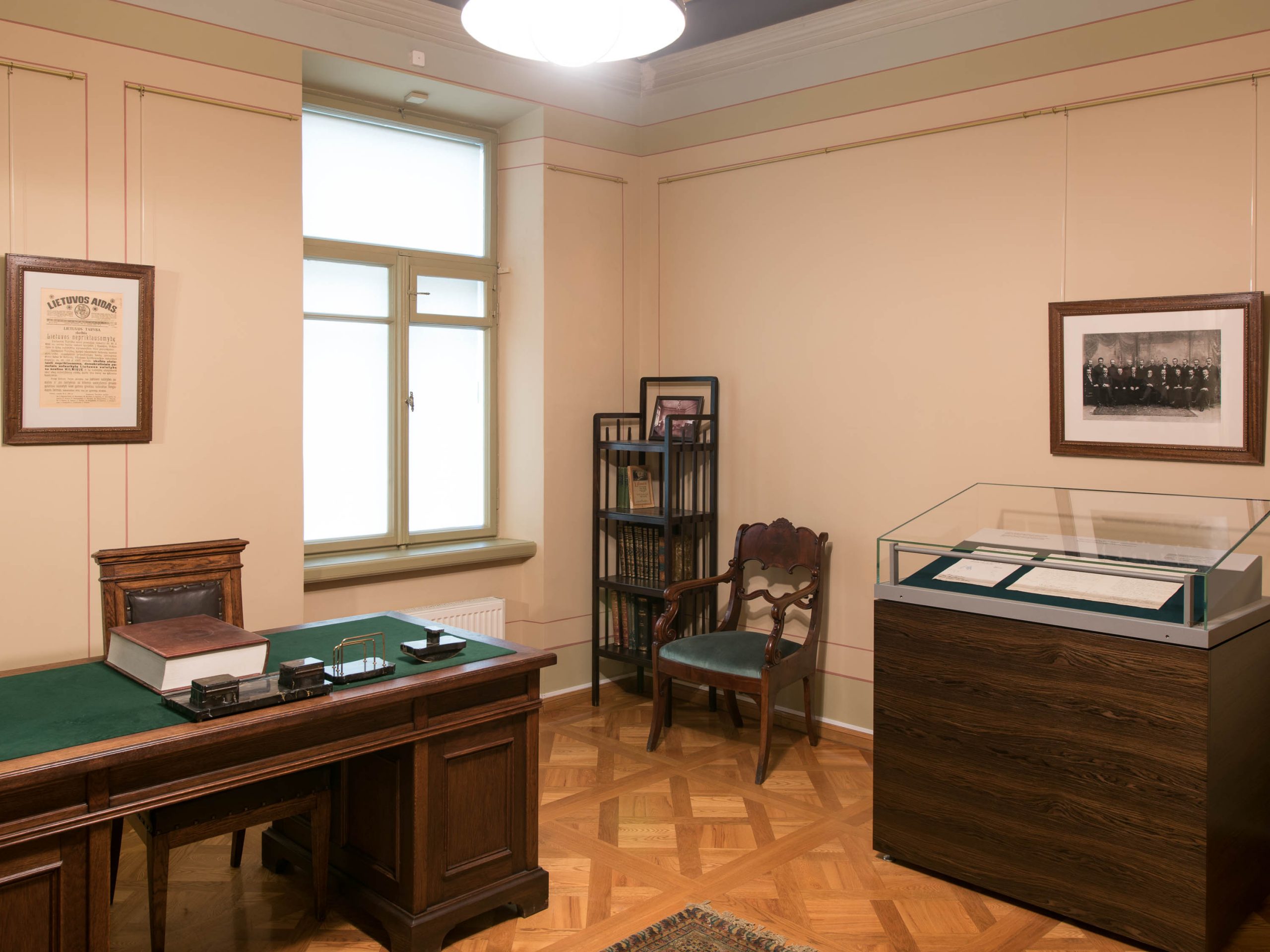
The Štralis family also rented apartments in the building to craftsmen, merchants and teachers. In 1915 they let an apartment on the third floor to the Lithuanian Society for Aiding Victims of War. Most of this society’s members (including future presidents of Lithuania Antanas Smetona and Aleksandras Stulginskis) were involved in efforts to create an independent Lithuanian state. It was therefore in this building that, on 16 February 1918, the Council of Lithuania held a historic meeting and signed the Act of Independence of Lithuania.
In 1992 the building became the House of the Signatories of the Lithuanian Act of Independence, and after less than a decade in became a branch of the National Museum of Lithuania.
Contacts
How to find us?
The entrance to the museum is on Pilies Street, in front of St. John’s Church. The nearest paid parking lot is at St. John’s Church.
The museum is accessible by public transport, the nearest stops (10 minutes walk) are Bernardinų sodas stop (33, 10, 11 buses), MO Muziejus stop (1G, 88, 53 bus, 1, 2, 7, 20 trolleybuses), Reformatų stop (21 bus, 1, 6, 7, 12, 20 trolleybuses).